Introduction to Buy and Sell Orders
In the world of investing, buy and sell orders are the fundamental tools investors use to execute their strategies. Understanding these orders and their various types can be the difference between making profits and minimizing losses. This article will provide you with a comprehensive guide on buy and sell orders, their types, uses, and how to apply them effectively in the financial markets.
Chapter 1: What are Buy and Sell Orders?
Definition of an Order
An order is an instruction given by an investor to their broker to buy or sell a specific financial asset, such as stocks, bonds, or currencies. The order specifies the price and quantity the investor wishes to transact.
Importance of Understanding Buy and Sell Orders
Understanding these orders helps investors to:
- Execute their investment strategies precisely.
- Manage risks effectively.
- Capitalize on market opportunities.
- Avoid costly mistakes.
Chapter 2: Main Types of Buy and Sell Orders
Market Order
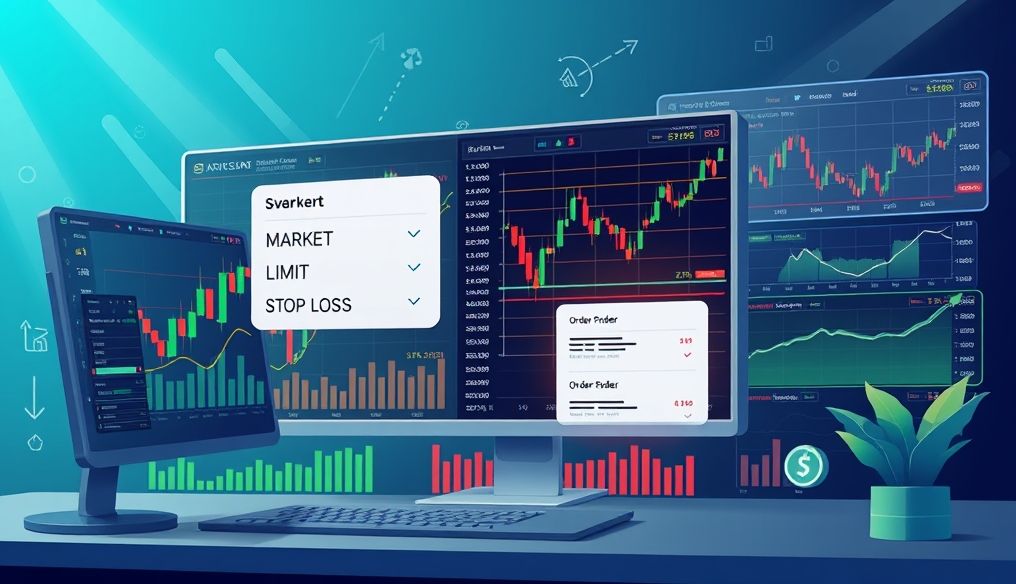
A market order is an instruction to buy or sell an asset at the best available price in the market at that moment. This order is typically the fastest to execute, but it may not guarantee the price you expect, especially in volatile markets.
Example: If you want to buy 100 shares of Apple (AAPL) as quickly as possible, you would use a market order. Your broker will buy the shares at the best price available in the market at that time.
Limit Order
A limit order is an instruction to buy or sell an asset at a specific price or better. This order guarantees the price you want, but it may not be executed if the market price does not reach the specified price.
Example: If you want to buy a stock at a price no higher than $150, you would use a limit order with a price of $150. The order will only be executed if the stock price drops to $150 or lower.
Stop Order
A stop order is an instruction to buy or sell an asset once the market price reaches a predetermined price (the stop price). Once the stop price is reached, the order converts to a market order and is executed at the best available price.
Example: If you own a stock at $200 and want to protect your profits, you can place a stop-loss order to sell at $180. If the stock price drops to $180, the shares will be sold automatically.
Stop-Limit Order
A stop-limit order combines the features of a stop order and a limit order. Once the market price reaches the stop price, the order converts to a limit order at the limit price.
Example: You can place a stop order at $180 and a limit order at $175. If the stock price drops to $180, the order will convert to a limit order to sell the stock at $175 or better.
Chapter 3: Other Types of Orders
Fill or Kill (FOK) Order
This order must be executed in its entirety immediately, or it will be canceled. This order is used when the investor needs the entire transaction to be completed or does not want it executed at all.
Immediate or Cancel (IOC) Order
This order must be executed partially or entirely immediately, and any unexecuted portion is canceled. This order allows the investor to obtain as much of the desired transaction as possible.
Good 'Til Canceled (GTC) Order
This order remains active in the market until it is executed or canceled by the investor. This type of order can be useful for investors with a long-term outlook.
Chapter 4: Uses of Different Buy and Sell Orders
Executing Trading Strategies
Different types of orders can be used to execute various trading strategies. For example, limit orders can be used to enter trades based on technical analysis, while stop orders can be used to protect profits and minimize losses.
Risk Management
Stop and stop-limit orders are powerful tools for risk management. They can be used to limit potential losses if the market moves against you.
Capitalizing on Market Volatility
Market orders can be used to capitalize on rapid market fluctuations, but caution should be exercised as they may result in trades being executed at unfavorable prices.
Chapter 5: Tips for Applying Buy and Sell Orders Effectively
- Understand Different Order Types: Make sure you fully understand how each type of order works, its risks, and its benefits.
- Define Your Investment Goals: Before placing any order, clearly define your investment goals. Are you looking for quick profits or a long-term investment?
- Analyze the Market: Analyze the market carefully before placing any order. Use technical and fundamental analysis to determine the best prices to enter and exit trades.
- Manage Risk: Use stop and stop-limit orders to protect your profits and minimize potential losses.
- Monitor Trades: Monitor your trades regularly and adjust your orders as needed.
Chapter 6: Practical Examples from the Arab and Global Markets
Example from the Saudi Market (Tadawul)
Suppose you are trading in the Saudi market and want to buy shares of Saudi Aramco. You can use a limit order to buy the shares at a specific price, or use a market order if you want to buy as quickly as possible.
Example from the US Market (NYSE)
Suppose you are trading on the New York Stock Exchange and want to sell shares of Tesla. You can use a stop order to protect your profits if you expect the stock price to decline.
Chapter 7: Common Mistakes to Avoid
- Not Understanding Order Types: This can lead to the execution of unwanted trades.
- Placing Unrealistic Orders: Placing limit orders at prices far from the current market price may result in them not being executed.
- Not Using Stop Orders: This can lead to significant losses if the market moves against you.
- Not Monitoring Trades: This can lead to missing opportunities to adjust orders or exit trades in a timely manner.
Chapter 8: The Impact of Technology on Buy and Sell Orders
Technology has revolutionized the way investors trade in financial markets. Online trading platforms have become more sophisticated, allowing investors to access a wide range of tools and features, including various types of advanced orders.
Algorithmic Trading: Algorithmic trading allows investors to place automated orders based on predetermined criteria. This can help execute investment strategies more efficiently and reduce the emotional impact on trading decisions.
Chapter 9: The Future of Buy and Sell Orders
Technology is expected to continue to play an increasingly important role in the development of buy and sell orders. We may see the emergence of new types of orders that use artificial intelligence and machine learning to improve performance and reduce risk.
Predictive Analytics: Predictive analytics can be used to forecast future market movements and improve the timing of order execution.
Chapter 10: Conclusion
Understanding buy and sell orders is an essential part of success in the financial markets. By understanding the different types of orders and how to use them effectively, you can execute your investment strategies precisely, manage risk, and capitalize on market opportunities. Always remember to analyze the market carefully and clearly define your investment goals before placing any order.
Disclaimer: This article is for informational purposes only and does not constitute financial advice. You should always consult with a qualified financial advisor before making any investment decisions.